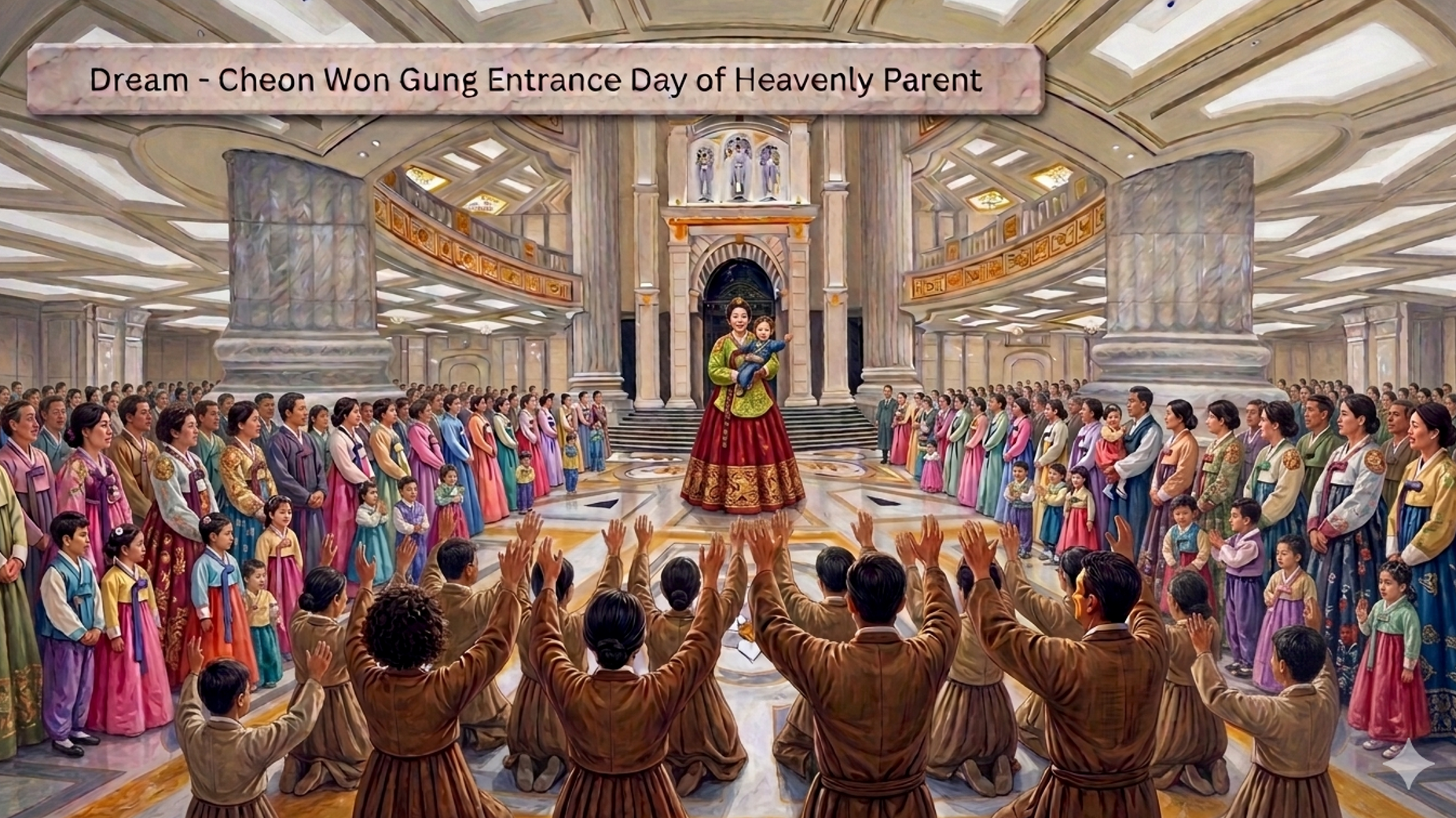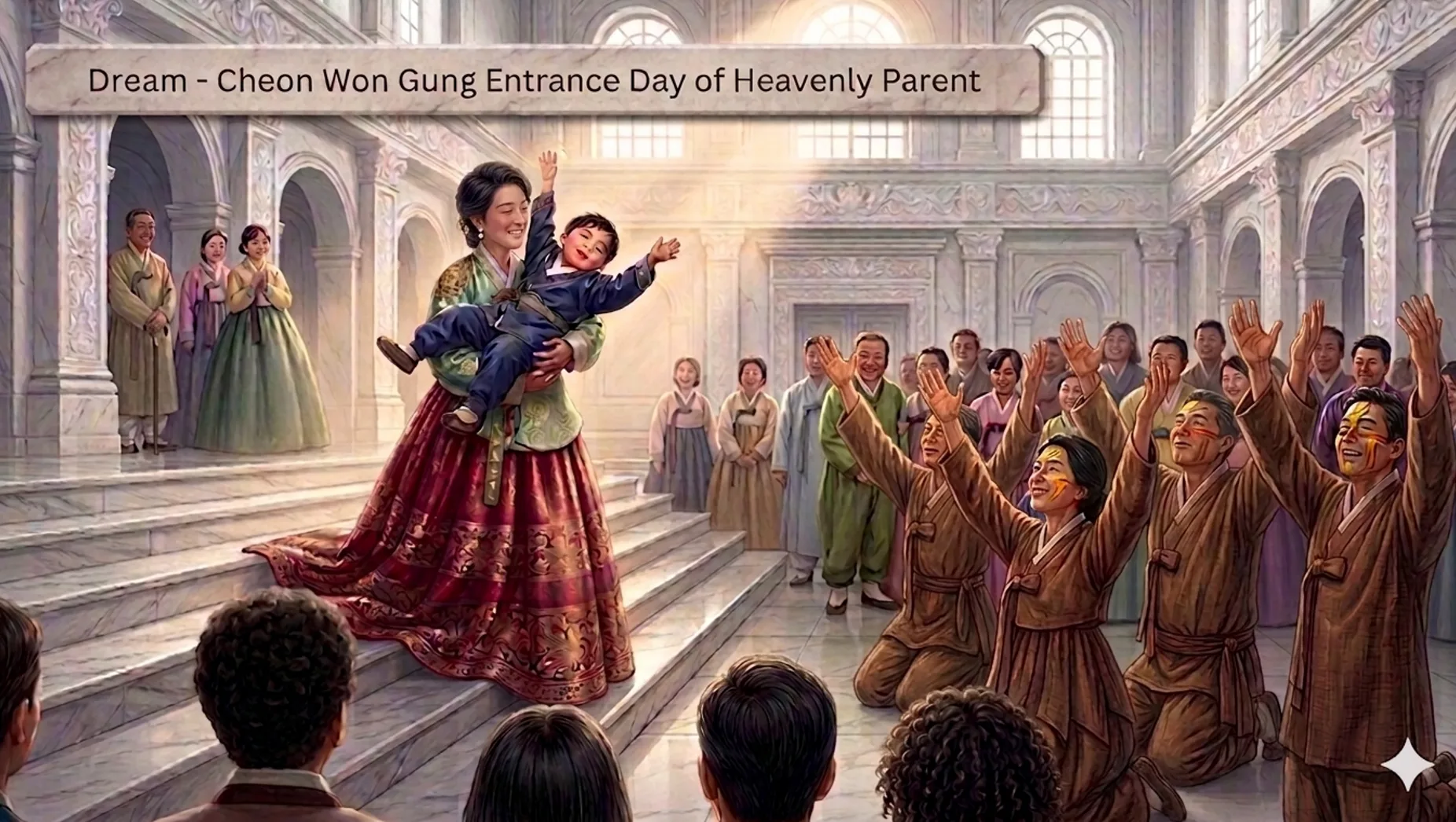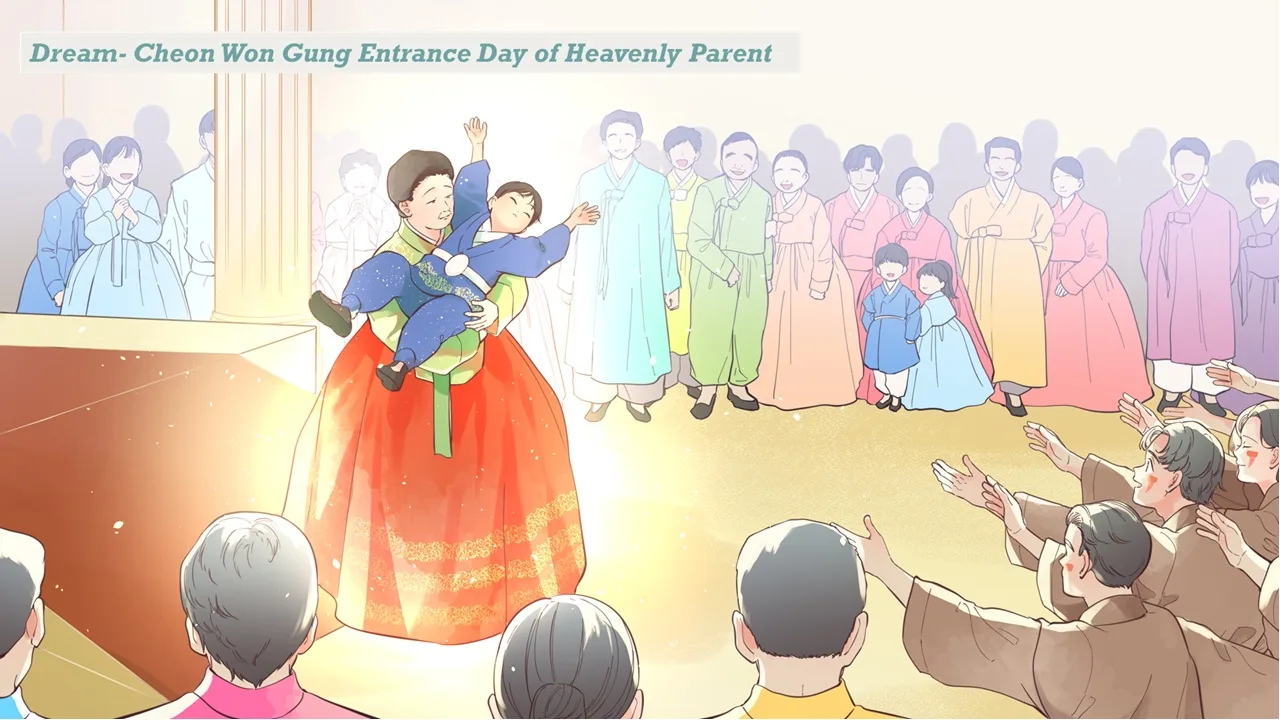
Painting: Cheon Won Gung Entrance Day of Heavenly Parent
← Back to Dreams

Cheon Won Gung Entrance Day of Heavenly Parent

Yeunhee Chang

Yeunhee Chang

Doctor of Ministry

Painting: Cheon Won Gung Entrance Day of Heavenly Parent
Click the image to view it full size
Screenshot 2026-08-05 at 10.46.08 PM.png
Screenshot 2026-08-05 at 10.45.58 PM.png

The Dream

I dreamt I was standing at the far end of a grand hall, just outside the doors to the main temple of what is called the Cheon Won Gung — God's Sanctuary. At the time of this dream, I had no idea what the interior of that place looked like. And yet I knew, with certainty, that I was standing inside it.

I could see the black and grey lines running through the white marble, and the hall stretching out before me, massive and luminous. On either side of a central staircase, thousands of people stood in brilliant, beautiful hanboks — every color radiant — all of them facing forward with great anticipation.

At the top of the stairs was Holy Mother Han. She was wearing a red and green hanbok and carrying a baby boy who looked to be about two years old. He was dressed in a deep blue, almost indigo, boy's hanbok, and he was joyously dancing in her arms. She carried him down the stairs as the crowds on either side watched in reverent silence, and then walked toward the back of the hall, where I was standing.

I looked down toward the floor and noticed a group of people kneeling, their hands raised in the air. I moved closer to see their faces. They had markings on them — like those of American Indians — and they were dressed in earth-toned hanboks that had the quality of a theatre troupe's costume. They held their hands up in song and praise as Holy Mother Han walked closer and closer toward them.

Reflection

That morning, when I woke up, I was awestruck by what I had seen. I was determined to remember the exact layout of the hall in relation to the temple — to find out whether what I had dreamed truly matched the real space. Later, I was able to confirm that it did.

But that morning, what surprised me most was the theatre troupe. I thought about who I knew connected to the performing arts, and I immediately thought of my dear friend who works at the Korean National Theatre. She was the only person in my waking life I could connect to that image. I found myself wondering why I had seen her there.

She and her husband both work at the theatre, and from time to time they would generously offer us tickets to their shows. Shortly after the dream, she offered me tickets to see what turned out to be the final run of a production called Paper Manshin, co-written by Colleen Park — a well-known vocalist and performer in South Korea.

I went with no particular expectation. What I found left me completely astonished.

The entire production centered on a young woman with the ability to offer salvation to the han-ridden souls of the world — han being that deep, generational feeling of sorrow, regret, and unresolved grief embedded in the Korean spirit. The show moved through Africa and the legacy of the slave trade, the American Indians and Death Valley, the forests of South America, and the border of North Korea.

I sat in that theatre stunned. The past year, Holy Mother Han had traveled to all of these very places — to do exactly that. To offer salvation and release the han-ridden souls, as the Only Begotten Daughter. It was as if Heaven was working through the Korean arts to announce something that even many within our own church — people who lived alongside the Only Begotten Daughter — had yet to fully understand about who she was.

I called my friend afterward and asked her to connect me with the writer. She did. And I asked her: how did this story come to you? How did you come to write it?

If you want to know her answer — come and listen to my lectures. It is something I look forward to sharing with you.